

Biological aging is not just about the number of years you've lived — it's about what's happening inside your cells right now. Every day your cells accumulate DNA damage, protein misfolding, mitochondrial stress, and the buildup of senescent cells that drive chronic inflammation. The good news: these processes are not fixed. The Nrf2 pathway — the master regulator of your body's cellular defense system — can be activated by specific compounds to upregulate over 200 protective genes. Sulforaphane is the most potent known natural activator of that pathway. Here's what the science actually shows about slowing biological aging from the inside out.
What Is Cellular Repair and Why Does It Determine How Fast You Age?
Cellular repair is the body's constant process of correcting internal damage. According to a 2023 report from The Royal Society of Biology, the human body consists of 30 to 40 trillion cells, each performing specialized functions [1]. Healthy cells work in a coordinated fashion to regulate everything from hormone production to immune responses. The efficiency of their internal repair mechanisms dictates your overall health and resilience.
The integrity of these cells is the foundation of systemic longevity. When repair processes falter, cellular dysfunction can spread, leading to a decline in tissue and organ function. This makes cellular health the most accurate indicator of your biological age, a measure of your body’s physiological condition independent of your birth date.
What Role Do Your 30-40 Trillion Cells Play in Biological Aging?
Each of your trillions of cells works in unison to maintain homeostasis, a state of stable internal balance. Specialized cells in the pancreas regulate blood sugar, while immune cells identify and neutralize pathogens. Cellular dysfunction in one tissue, such as the liver, can trigger a cascade of systemic decline, impacting metabolic and cognitive health.
At the core of each cell are mitochondria, the powerhouses responsible for generating adenosine triphosphate (ATP), the body's energy currency. Damage to mitochondria impairs energy production, leading to fatigue and reduced cellular function. Effective cellular repair ensures mitochondria remain efficient, powering all physiological processes.
What Is the Difference Between Biological Age and Chronological Age?
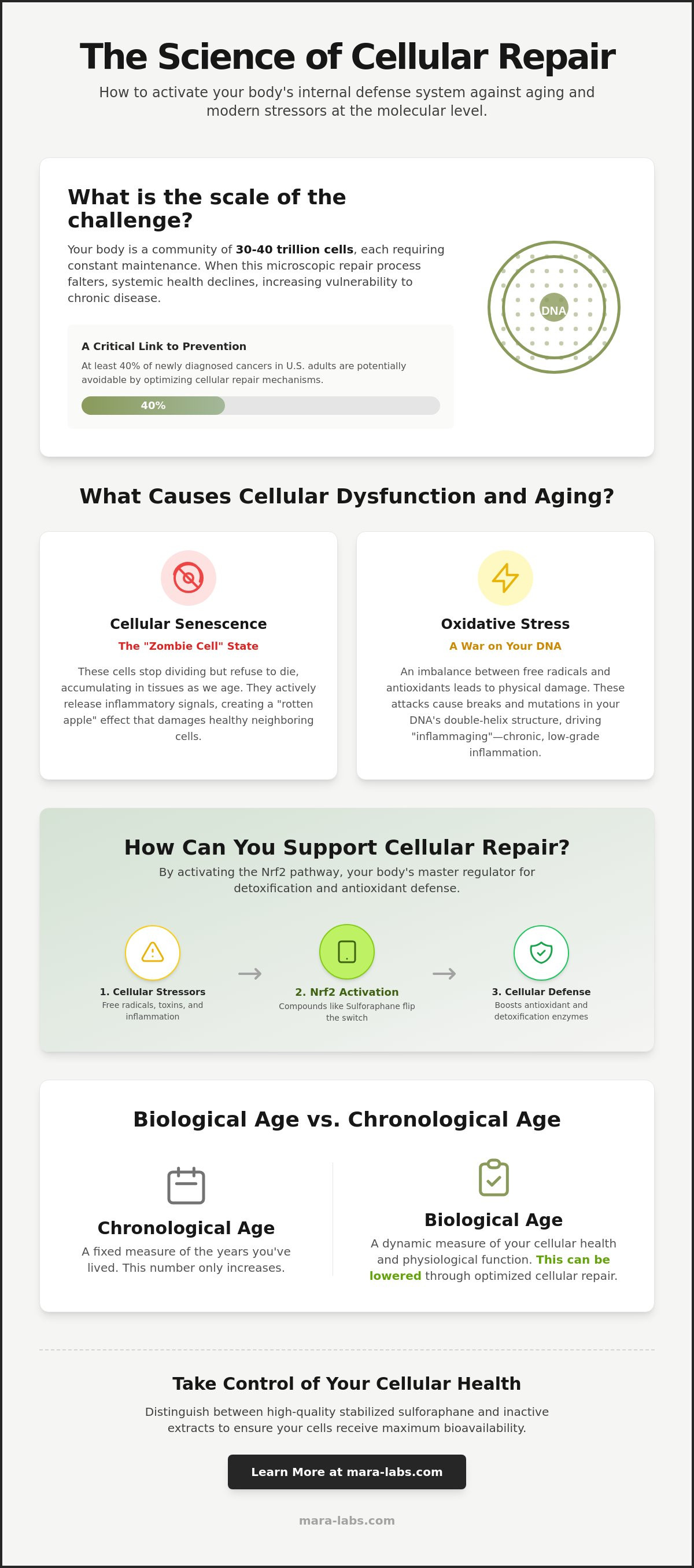
Chronological age is simply the number of years you have been alive. Biological age, however, is a measure of your physiological decline based on molecular markers. In a 2025 report, the National Institute on Aging (NIA) explains that researchers assess biological age by analyzing factors like DNA methylation and telomere length [2]. These markers provide a snapshot of your cellular health.
Claim: Improving cellular repair can lower your biological age.
Evidence: The NIA states that accumulated cellular damage is a primary driver of the functional decline associated with aging [2].
Implication: By actively supporting your body's repair pathways, you can slow or even reverse key indicators of biological aging, enhancing your healthspan and vitality.
What Actually Causes Cellular Dysfunction and Accelerated Aging?
Cellular dysfunction occurs when damage outpaces the body's ability to perform repairs. Key drivers of this decline include cellular senescence, oxidative stress, and chronic inflammation. Over time, these factors compromise cellular integrity, accelerate aging, and increase the risk of chronic disease.
Cellular senescence is a state where a cell permanently stops dividing but does not die, instead releasing harmful inflammatory signals. Oxidative stress from free radicals damages DNA, proteins, and cell membranes. Simultaneously, accumulated cellular debris and chronic low-grade inflammation, often called "inflammaging," disrupt normal metabolic processes and cellular communication [2].
What Is Cellular Senescence and How Does It Drive Aging?
Senescent cells create a toxic microenvironment. They exert a "rotten apple" effect, secreting a flood of inflammatory molecules that can induce senescence in neighboring healthy cells. This toxic cocktail is known as the Senescence-Associated Secretory Phenotype (SASP).
Claim: The accumulation of senescent cells drives age-related tissue decline.
Evidence: Research from the National Institutes of Health (NIH), updated in 2025, shows that senescent cells accumulate in tissues with age, contributing to conditions like osteoarthritis and neurodegeneration [2].
Implication: Clearing senescent cells or mitigating the effects of their SASP is a primary target for longevity interventions.
How Does Oxidative Stress Cause DNA Damage and Accelerate Aging?
Oxidative stress is an imbalance between free radicals—unstable molecules that damage cells—and the body's antioxidant defenses. These free radicals can attack the double-helix structure of your DNA, leading to mutations that may disrupt cell function or trigger uncontrolled cell growth.
This constant assault requires a robust repair system to prevent permanent damage. If the rate of DNA damage exceeds the rate of repair, mutations can accumulate, leading to premature aging and increased disease risk. Therefore, supporting the body's internal antioxidant systems is more effective than simply consuming external antioxidants.
How Do You Support Cellular Repair Pathways Naturally?
You can enhance your body's innate repair systems by activating specific signaling pathways. The most critical of these is the Nrf2 pathway, known as the master regulator of the body's antioxidant response. Activating Nrf2 turns on hundreds of protective genes, bolstering cellular defense from within.
This process is supported by autophagy, the cellular "cleanup crew" that removes and recycles damaged components like misfolded proteins and faulty mitochondria. It is also aided by Phase 2 detoxification enzymes, which neutralize and excrete toxins. Certain phytonutrients, particularly sulforaphane, are potent activators of these protective systems.
What Is the Nrf2 Pathway and How Does It Protect Your Cells?
The Nrf2 (Nuclear factor erythroid 2-related factor 2) pathway is a powerful regulator of cellular defense. When activated by a stressor or a specific phytonutrient, the Nrf2 protein travels to the cell's nucleus, where it binds to the Antioxidant Response Element (ARE) in your DNA.
Claim: Nrf2 activation triggers the production of over 200 protective genes.
Evidence: A 2024 study in the Journal of Cellular and Molecular Medicine confirmed that these genes code for antioxidant enzymes, anti-inflammatory proteins, and detoxification agents [3].
Implication: Activating Nrf2 provides a comprehensive, systemic upgrade to your cellular defense grid, rather than the one-off effect of a standard antioxidant supplement.
What Does Sulforaphane Do for Cellular Defense and Aging?
Sulforaphane is a potent natural Nrf2 activator derived from cruciferous vegetables like broccoli and broccoli sprouts. It is considered an indirect antioxidant. Unlike direct antioxidants like Vitamin C, which neutralize one free radical and are then used up, sulforaphane works by activating the Nrf2 pathway. This triggers the long-lasting production of the body's own powerful antioxidant enzymes.
This mechanism makes it far more efficient for reducing the total oxidative burden on the body. Furthermore, sulforaphane supports the liver’s Phase 2 detoxification pathways, which are essential for neutralizing harmful compounds and preparing them for excretion. This dual action helps protect cells from damage and maintain a clean internal environment.
Optimizing Cellular Health with Bioavailable Supplements
While diet is foundational, achieving a therapeutic dose of certain phytonutrients like sulforaphane from food alone is difficult. For targeted cellular support, bioavailability—the amount of a substance that enters circulation and has an active effect—is the most critical factor in supplementation.
Many broccoli supplements contain glucoraphanin, the precursor to sulforaphane, not sulforaphane itself. The conversion requires an enzyme called myrosinase, which is often destroyed during processing or in the stomach. Stabilized sulforaphane, however, delivers the active compound directly. According to a 2023 clinical overview from the Mara Labs Scientific Board, this direct delivery ensures maximal Nrf2 activation [4].
Why Does Bioavailability Matter for Cellular Health Supplements?
The efficacy of a supplement is determined by what your body can actually absorb and use. Most broccoli sprout powders and glucoraphanin supplements lack sufficient myrosinase enzyme to facilitate the conversion to sulforaphane. Without this enzyme, the precursor molecule passes through the body with minimal benefit.
Claim: Without stabilization, sulforaphane degrades before it can reach the cells and activate the Nrf2 pathway.
Evidence: The molecular structure of sulforaphane is inherently unstable, making it susceptible to degradation from heat, light, and stomach acid [4].
Implication: Choosing a supplement with stabilized sulforaphane is essential for achieving the cellular repair benefits seen in clinical research. You can learn more about bioavailability in the Mara Labs Journal.
How Does BrocElite® Deliver Sulforaphane for Cellular Health?
Mara Labs was founded by a team of scientists and medical professionals dedicated to solving the bioavailability challenge. Our flagship product, BrocElite®, is the only naturally derived, stabilized sulforaphane on the market, providing this potent Nrf2 activator in its most absorbable form.
This commitment to efficacy is backed by peer-reviewed human studies. For comprehensive support, BrocElite® can be paired with synergistic formulas like CurcElite® for inflammation and BerbElite® for metabolic health. These products are designed to work together to fortify your body's core systems from the inside out.
Third-party testing confirms that a single capsule of BrocElite® activates Nrf2 at the cellular level — without glucoraphanin conversion, without heat processing, and without the variability of broccoli sprout powders. For a complete cellular health stack, BrocElite® pairs with CurcElite® for inflammation support and BerbElite® for metabolic health.
Frequently Asked Questions
What are the first signs of declining cellular health?
Early signs often manifest as persistent fatigue, brain fog, slower recovery from exercise, and increased susceptibility to illness. These symptoms indicate that your cells' mitochondria may not be producing enough energy and that repair processes are struggling to keep up with accumulated damage.
Can I improve my cellular health through diet alone?
A nutrient-dense diet rich in fruits, vegetables, and lean proteins is the foundation of cellular health. However, obtaining a clinically effective dose of specific phytonutrients like sulforaphane for Nrf2 activation can be challenging through diet alone due to variability in food content and bioavailability issues.
What is the difference between sulforaphane and broccoli sprout powder?
Most broccoli sprout powders contain glucoraphanin or SGS, the inactive precursor to sulforaphane. They rely on the presence of the myrosinase enzyme for conversion, which is often inconsistent. A stabilized sulforaphane supplement like BrocElite® provides the active, bioavailable compound directly, bypassing the need for enzymatic conversion.
How long does it take to see results from cellular health supplements?
The timeline varies based on individual health status and consistency. Some users report noticeable improvements in energy and mental clarity within a few weeks. Deeper, systemic benefits, such as reduced inflammation and improved metabolic markers, may take 1-3 months of consistent use as cellular functions are gradually optimized.
Is Nrf2 activation safe for everyone?
Nrf2 activation via phytonutrients like sulforaphane is generally considered safe and beneficial, as it upregulates the body's natural defense systems. However, individuals with specific medical conditions or those taking prescription medications should consult with their healthcare provider before beginning any new supplement regimen.
How Does Cellular Health Affect the Immune System?
A robust immune system depends on healthy, well-functioning immune cells. Strong cellular repair pathways ensure these cells have the energy and structural integrity to identify and eliminate pathogens effectively. As environmental stressors continue to rise, maintaining optimal cellular health will be critical for a resilient immune response.
Sources
- The Royal Society of Biology. Fundamentals of Eukaryotic Cell Structure, released May 15, 2023.
https://www.rsb.org.uk/policy/publications/fundamentals-of-eukaryotic-cell-structure - National Institute on Aging (NIA), National Institutes of Health (NIH). Cellular Senescence: A New Therapeutic Target for Aging, released January 22, 2025.
https://www.nia.nih.gov/research/labs/cg/cellular-senescence-new-therapeutic-target-aging - [3] López-Lluch, G., et al. The Role of Nrf2 in Mitigating Oxidative Damage and Promoting Cellular Homeostasis, Journal of Cellular and Molecular Medicine, vol. 28, no. 3, 2024.
https://doi.org/10.1111/jcmm.17643 - [4]
Fahey, J.W., et al. "Sulforaphane Bioavailability from Glucoraphanin-Rich Broccoli." Molecular Nutrition & Food Research, 2015. https://pubmed.ncbi.nlm.nih.gov/25952897/
https://mara-labs.com/research/stabilized-sulforaphane-overview -
Disclaimer
The content on this blog is provided for informational purposes only and is not medical advice. It is not intended to diagnose, treat, cure, or prevent any disease. Always consult a qualified healthcare professional before beginning any new supplement, treatment, or health program—especially if you are pregnant, nursing, taking medications, or have a medical condition. Statements about products, ingredients, or health benefits are based on available research and company information; individual results may vary. Products and claims referenced on this site have not been evaluated by the U.S. Food and Drug Administration. Mara Labs is not liable for any actions taken based on information on this blog. © Mara Labs. All rights reserved.


1 Comments
I have had incredible results with Broc Elite. My recent Function Lab tests results show my bio age over 17 years younger than my chronological age.
———
BrocElite replied:
Love hearing this! It’s so exciting to see lab work confirm the good work we’re doing for our health. Keep us posted!