
Bottled water is regulated by the FDA to standards equivalent to municipal tap water, with strict limits on lead (5 parts per billion), PFAS, and bacterial contamination [3]. The bigger issue isn't what regulators measure — it's what they don't. A 2024 study using advanced imaging found an average of 240,000 plastic particles per liter of bottled water, most of them nanoplastics small enough to cross into the bloodstream [2]. The EPA added microplastics to its priority contaminant list in April 2026 [5]. The practical takeaway: choose glass or stainless steel where possible, avoid heat exposure for any plastic-bottled product, and support your body's natural detoxification pathways with targeted nutrition.
Key Takeaways
- The FDA regulates bottled water as a packaged food and requires it to meet safety standards equivalent to EPA-regulated tap water [3].
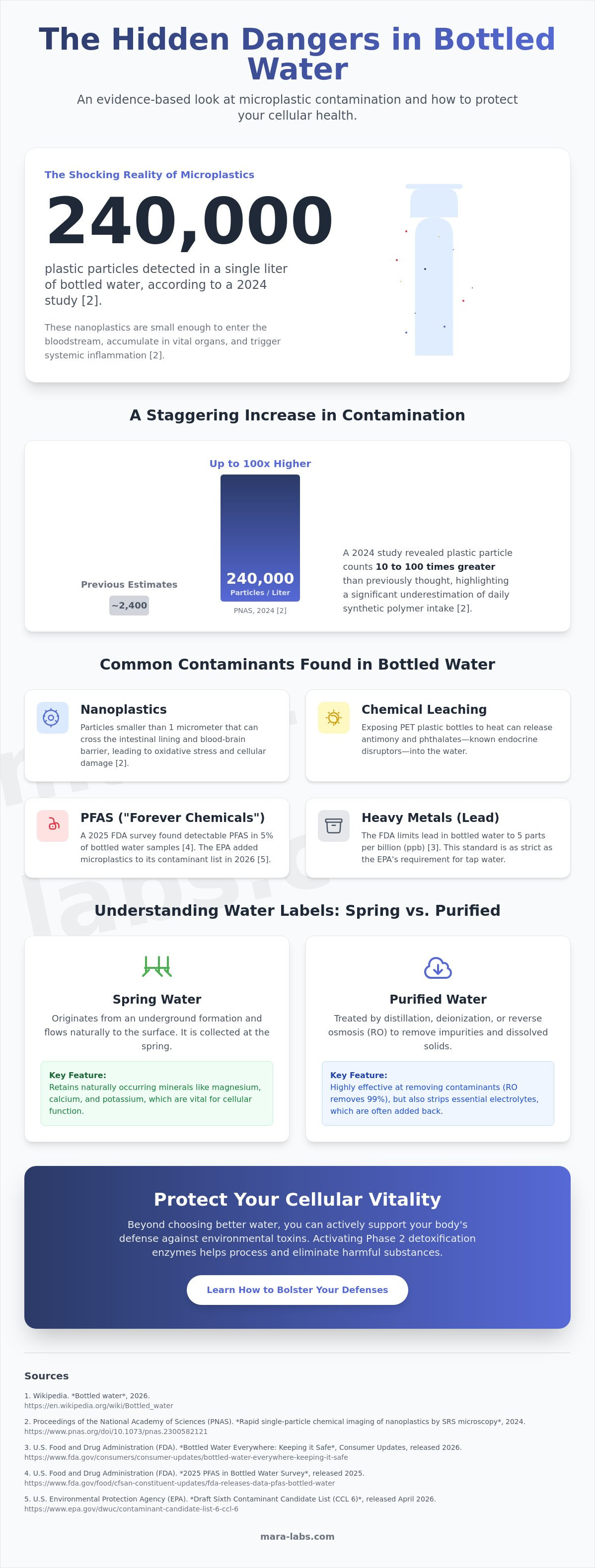
- Microplastics are the contamination story regulators are still catching up to. A 2024 PNAS-published study identified up to 240,000 particles per liter, 10–100× higher than previous estimates [2].
- Heat is the enemy of PET plastic. Storing bottles in hot cars or sunlight accelerates leaching of antimony and phthalates, both endocrine-active compounds.
- "Spring," "mineral," and "purified" are not interchangeable. Mineral water requires ≥250 ppm total dissolved solids by FDA rule; purified water often has minerals stripped out entirely [3].
- Activating Phase II detoxification enzymes through compounds like sulforaphane supports your body's natural processing of environmental contaminants [6].
- Glass and stainless steel eliminate leaching risk. They're chemically inert and don't shed plastic particles.
What are the different types of bottled water?
Bottled water is drinking water packaged in plastic or glass containers. Wikipedia (2026) explains that these products are categorized by their specific geological source and treatment methods [1]. In 2026, the U.S. Food and Drug Administration (FDA) regulates these as packaged foods to maintain safety standards [3]. This regulatory framework ensures that the water you consume meets established health criteria before it reaches your home. Understanding different types of bottled water allows you to make informed decisions for your unique biology.
What's the difference between spring water and mineral water?
Spring water must originate from an underground formation where water flows naturally to the surface. It's often favored for its natural pH balance and perceived purity. This water must be collected only at the spring or through a borehole tapping the underground formation. Mineral water is distinguished by its constant proportion of minerals and trace elements at the point of emergence. To be labeled as mineral water, the FDA (2026) requires at least 250 parts per million (ppm) of total dissolved solids [3].
These sources provide consistent levels of trace elements like magnesium, calcium, and potassium. These minerals are vital for maintaining cellular electrical gradients and supporting bone health. Many consumers prefer spring water because it's typically less processed than municipal alternatives. It retains the geological character of its origin, providing a complex profile of electrolytes. Choosing a high-mineral source can be a pragmatic way to supplement your daily nutrient intake naturally.
What is purified water (and is it good for you)?
Purified water is treated through distillation, deionization, or reverse osmosis (RO). RO systems are highly effective; they remove 99% of contaminants, including heavy metals and PFAS. This process involves forcing water through a semi-permeable membrane to strip away microscopic impurities. Distilled water is created by boiling water into vapor to eliminate all dissolved solids and bacteria. While this ensures absolute purity, it creates a "blank slate" that may not support hydration perfectly.
Distilled water often lacks the essential electrolytes required for optimal cellular hydration and signal transmission. When water is devoid of minerals, it can technically pull small amounts of minerals from your body to reach equilibrium. Many brands add minerals back to these purified waters to improve taste and bioavailability. This helps ensure that the water supports your metabolic processes rather than just quenching thirst. You can explore more about metabolic health and cellular resilience in our health journal.
How many microplastics are in bottled water?
The primary health risks of bottled water involve microplastic ingestion and chemical leaching from plastic packaging. A 2024 study revealed that one liter of bottled water contains approximately 240,000 plastic particles [2]. These particles and chemicals like phthalates can enter the bloodstream, potentially triggering inflammation and disrupting hormonal signaling. We must look beyond the convenience of plastic to understand its biological cost.

Recent data from the Proceedings of the National Academy of Sciences found that particle counts are 10 to 100 times higher than previous estimates [2]. This discovery suggests that we've significantly underestimated our daily intake of synthetic polymers. These microscopic fragments represent a persistent physiological burden that requires active cellular defense.
How many microplastics are in bottled water?
A 2024 study published in the Proceedings of the National Academy of Sciences found an average of 240,000 plastic particles per liter of commercial bottled water — 10 to 100 times higher than previous estimates [2]. Most of those particles are nanoplastics (smaller than 1 micrometer), which earlier detection methods couldn't see.
The size matters because of where these particles can go:
- Microplastics are particles smaller than 5 millimeters
- Nanoplastics are smaller than 1 micrometer — small enough to migrate through the intestinal lining and enter the bloodstream [2]
Once nanoplastics enter circulation, research suggests they can accumulate in organs and tissues, including crossing the blood-brain barrier and the placenta [2]. The long-term physiological implications are still being characterized in active research, but the immune system appears to recognize these particles as foreign and mount an inflammatory response.
This is the contamination story regulators are catching up to. Standard FDA bottled water testing wasn't designed for this category of contaminant, which is why the 2026 EPA priority listing matters [5].
What chemicals leach from plastic water bottles?
The two main chemicals of concern that leach from PET plastic bottles are antimony (a heavy metal used as a polymerization catalyst) and phthalates (a class of plasticizers). Both are present in PET at trace levels, and both migrate into water at higher rates under heat and UV exposure.
Conditions that significantly accelerate leaching:
- Heat — bottles left in hot cars, sun, or warm storage
- Time — extended storage, especially in warm conditions
- UV exposure — direct sunlight on the bottle
- Reuse — repeated use of single-use PET bottles increases cumulative exposure
Phthalates are classified as endocrine-disrupting compounds — they can interfere with hormonal signaling, which has implications for metabolic health. Antimony is a heavy metal that can accumulate in tissue over time. Neither shows up in standard FDA bottled water testing because both stay below regulatory thresholds at room-temperature storage. The threshold is exceeded primarily by user conditions (the hot car), which is why behavior matters as much as the product itself.
How is bottled water regulated in 2026?
The U.S. Food and Drug Administration (FDA) regulates bottled water as a packaged food product to ensure it remains as safe as municipal tap water [3]. Manufacturers must adhere to Current Good Manufacturing Practices (CGMP) for sanitary production and processing. In 2026, the FDA maintains a strict limit of 5 parts per billion for lead in these products [3]. This oversight ensures that the water you buy meets essential quality benchmarks before consumption.
Labeling requirements serve as another critical layer of consumer protection. Manufacturers must clearly state the water type, such as mineral or spring, and identify any supplemental treatments. CGMP inspections verify that facilities prevent botanical or chemical contamination during the bottling process. These standards prevent the growth of harmful bacteria and ensure the integrity of the final product.
FDA vs. EPA: who actually monitors your water?
While the EPA oversees public tap water, the FDA manages the bottled water market. Municipalities typically test for contaminants hundreds of times each month. In contrast, bottled water facilities conduct testing less frequently but must keep detailed records for inspection. Transparency levels differ because annual city water reports are public, whereas bottled water quality data often requires a direct request from the manufacturer.
Regulatory focus shifted in 2025 after an FDA survey of 197 samples showed detectable PFAS in only 5% of products [4]. On April 2, 2026, the U.S. Environmental Protection Agency (EPA) announced the draft of its Sixth Contaminant Candidate List [5]. This list includes microplastics and pharmaceuticals as priority contaminant groups for evaluation. Understanding the health effects of microplastics is vital as these regulations evolve to protect your cellular integrity. The public comment period for these new standards ends on June 5, 2026 [5].
International Standards: IBWA and WHO
Global safety is guided by the World Health Organization (WHO) and regional bodies like the EU Food Standards. The International Bottled Water Association (IBWA) also sets voluntary industry standards that often exceed federal requirements. These benchmarks ensure a consistent level of purity and mineral content across international borders. We believe that rigorous methodology is the only way to safeguard your long-term well-being and maintain internal purity.
You can take control of your environmental toxic load by choosing science-backed cellular support to bolster your natural defenses against these emerging contaminants.
How do you reduce your exposure to bottled water contaminants?
Minimizing plastic exposure is a primary step in reducing the systemic inflammatory load from water contaminants. When we reduce this load, we allow our internal systems to recover and thrive. Supporting natural detoxification pathways, specifically Phase 2 enzymes, helps the body process environmental toxins efficiently.
We recommend transitioning away from standard plastic bottled water to reduce your intake of nanoplastics. These particles can trigger oxidative stress once they enter the bloodstream [2]. Protecting your cellular health requires both external avoidance and internal fortification.
How does the Nrf2 pathway support detoxification?
Nrf2 serves as the "master regulator" of your body's antioxidant response. It activates genes that produce protective enzymes and antioxidants to defend your cells. Sulforaphane is a potent natural Nrf2 activator that supports liver health and detoxification [6].
You can find deeper insights into sulforaphane science in the Mara Labs Journal. This compound enhances the body's ability to neutralize the synthetic particles and chemicals found in commercial water. Activating this pathway provides a clinical-grade defense against modern environmental stressors.
What's the best alternative to plastic bottled water?
Stainless steel and glass containers are the most effective way to eliminate leaching risks. These materials are chemically inert and do not shed microplastics into your beverages. They provide a safe, sustainable way to maintain hydration without compromising your hormonal health.
For home use, multi-stage carbon and ion-exchange filters provide superior protection against municipal contaminants. These systems remove heavy metals and organic pollutants that standard filters might miss. You can also shop bioavailable supplements to further optimize your cellular resilience against environmental toxins.
Sources
[1] Wikipedia. Bottled water, released May 2026.
https://en.wikipedia.org/wiki/Bottled_water
[2] National Institutes of Health (NIH). Plastic particles in bottled water, NIH Research Matters, released January 2024.
https://www.nih.gov/news-events/nih-research-matters/plastic-particles-bottled-water
[3] U.S. Food and Drug Administration (FDA). Bottled Water Everywhere: Keeping it Safe, Consumer Updates, released 2026.
https://www.fda.gov/consumers/consumer-updates/bottled-water-everywhere-keeping-it-safe
[4] U.S. Food and Drug Administration (FDA). 2025 PFAS in Bottled Water Survey, released 2025.
https://www.fda.gov/food/cfsan-constituent-updates/fda-releases-data-pfas-bottled-water
[5] U.S. Environmental Protection Agency (EPA). Draft Sixth Contaminant Candidate List (CCL 6), released April 2026.
https://www.epa.gov/dwuc/contaminant-candidate-list-6-ccl-6
[6] National Institutes of Health (NIH). Sulforaphane and Its Effects on Cancer and Inflammation, PMC, released 2023.
https://www.ncbi.nlm.nih.gov/pmc/articles/PMC10385584/
Take Control of Your Hydration and Cellular Health
Bottled water safety depends on the container material and the source's filtration. While FDA standards ensure low lead and PFAS, the high concentration of nanoplastics poses a physiological risk [2][3]. You can protect your health by choosing glass and activating your internal detoxification pathways.
Activating the Nrf2 pathway allows your cells to neutralize environmental toxins more effectively. Our medical scientists developed BrocElite to provide stabilized sulforaphane for maximum bioavailability. This clinically backed intervention triggers the body’s antioxidant response to protect your cellular integrity.
Support your cellular defense with BrocElite sulforaphane to bolster your resilience against modern contaminants. We're here to guide you toward a life of purity and lasting health. You have the tools to optimize your well-being in an increasingly complex world.
Frequently Asked Questions
Is bottled water safer than tap water in 2026?
Bottled water isn't inherently safer than municipal tap water in 2026. Both sources must meet stringent safety standards. The FDA requires bottled water to be as protective of public health as EPA-regulated tap water [3]. However, tap water undergoes more frequent testing by local municipalities. Conversely, bottled water often contains significantly higher levels of nanoplastics which can enter your bloodstream [2].
Does bottled water expire or go bad over time?
Water doesn't expire, but the plastic container eventually degrades and leaches chemicals. The FDA doesn't mandate expiration dates for these products. However, the integrity of PET plastic decreases over time. When stored in warm environments, the bottle can release antimony and phthalates into the water. We recommend consuming it within two years of production for maximum safety.
What are the healthiest brands of bottled water to buy?
The healthiest options provide high mineral content in glass packaging. Look for "Mineral Water" labels, which require at least 250 parts per million of total dissolved solids [3]. These products provide essential electrolytes like magnesium and calcium. Choosing glass prevents the ingestion of the 240,000 plastic particles typically found in plastic-packaged water [2]. Avoid brands using generic "purified" labels without added minerals.
Do all plastic water bottles contain microplastics?
Current research suggests that the vast majority of plastic bottles contain microscopic fragments. A 2024 study using advanced imaging found an average of 240,000 nanoplastics per liter of bottled water [2]. These particles are small enough to cross the blood-brain barrier. While the EPA added microplastics to its priority list in 2026, they remain a common contaminant in nearly all PET-packaged beverages [5].
How can I tell if my bottled water contains PFAS?
You can identify PFAS levels by checking the 2025 FDA retail survey results. This study found detectable PFAS in only 5% of the 197 samples tested [4]. To be certain about a specific brand, contact the manufacturer for their latest Water Quality Report. These reports detail the concentrations of regulated chemicals and provide transparency regarding their filtration and sourcing methods.
Is glass-bottled water worth the extra cost?
Glass-bottled water is worth the investment for those prioritizing long-term cellular health. Glass is chemically inert and doesn't leach endocrine disruptors like phthalates into your drink. This choice eliminates the risk of consuming the nanoplastics found in standard plastic packaging [2]. By choosing glass, you reduce the systemic inflammatory load on your body and support your natural detoxification pathways.
Can I just reuse plastic bottles to reduce waste?
This isn't ideal. Single-use PET wasn't designed for repeated use, and repeated washing and refilling accelerates degradation of the plastic. Switch to a refillable stainless steel or glass bottle for the same waste-reduction benefit without the leaching trade-off.
Does freezing bottled water release chemicals?
Freezing doesn't significantly increase chemical leaching from PET plastic — heat does. Cold storage is fine. The viral claim that freezing plastic bottles releases dioxins has been debunked by the FDA. The actual leaching risk is warm storage, sunlight, and reuse.
Disclaimer
The content on this blog is provided for informational purposes only and is not medical advice. It is not intended to diagnose, treat, cure, or prevent any disease. Always consult a qualified healthcare professional before beginning any new supplement, treatment, or health program—especially if you are pregnant, nursing, taking medications, or have a medical condition. Statements about products, ingredients, or health benefits are based on available research and company information; individual results may vary. Products and claims referenced on this site have not been evaluated by the U.S. Food and Drug Administration. Mara Labs is not liable for any actions taken based on information on this blog. © Mara Labs. All rights reserved.


0 Comments