
Key Takeaways
Reading this blog, you will be able to:
- Identify the different ways microplastics enter your body.
- Understand how microplastics cause chronic inflammatory responses at the cellular level.
- Implement immediate 2-3 household changes that will significantly reduce your daily microplastic exposure.
- Discover how the Nrf2 pathway acts as a master regulator to upregulate your body's natural antioxidant and detoxification genes.
- Learn how sulforaphane supports Phase II detoxification enzymes to neutralize chemical toxins carried by environmental pollutants.
What Are Microplastics and How Do They Get Into the Human Body?
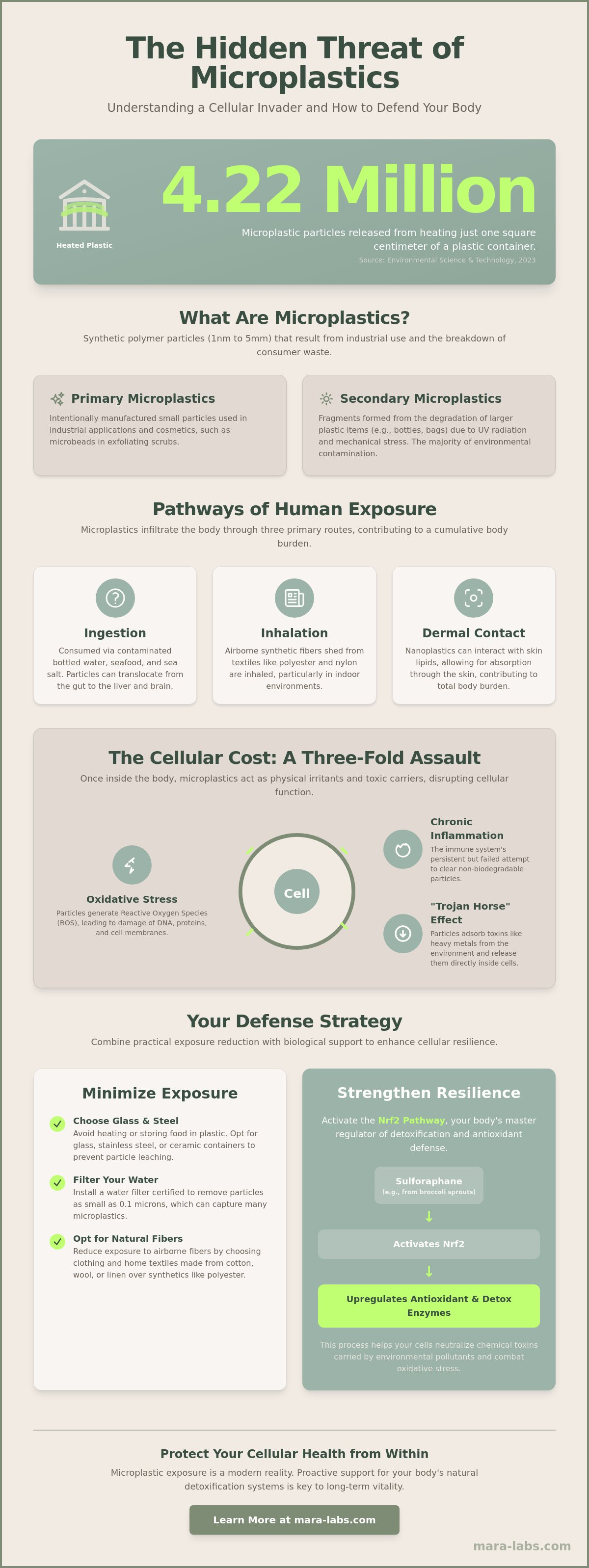
Microplastics are synthetic polymer particles ranging from 1 nanometer to 5 millimeters in size. They infiltrate the human body through ingestion, inhalation, and dermal contact. In 2024, cardiovascular research identified these particles in 58.4% of human atherosclerotic plaques [1]. This presence correlates with an increased risk of myocardial infarction and stroke. Understanding what microplastics are is the first step toward mitigating their biological impact. You can't avoid exposure entirely, but you can understand the pathways to better protect your health.
What Is the Difference Between Primary and Secondary Microplastics?
Primary microplastics are intentionally manufactured for industrial applications and cosmetic products like exfoliating microbeads. Secondary microplastics result from the degradation of larger consumer waste. UV radiation and mechanical stress break down common polymers like polyethylene and polypropylene over decades. These secondary fragments represent the majority of environmental contamination today. They're often too small to be seen but remain biologically active once inside your system. Manufacturers use these polymers because they're durable and inexpensive to produce, yet this durability ensures they persist in the environment for centuries.
What Does the 2026 Research Show About Human Microplastic Exposure?
Humans consume microplastics through contaminated bottled water, sea salt, and seafood. Heating plastic containers can release 4.22 million particles from one square centimeter [3]. Synthetic textiles like polyester fleece shed millions of airborne fibers that you inhale indoors. A 2025 systematic review confirmed that these particles translocate to the liver and brain [2]. Autopsy data revealed microplastic concentrations of 26,076 μg/g in the brains of dementia patients [2]. This evidence highlights the urgent need for protective protocols discussed in our health journal.
The U.S. EPA added microplastics to the Contaminant Candidate List in April 2026 [4]. This move signals a shift toward regulating public drinking water systems to reduce the cumulative body burden. Staying informed helps you choose safer alternatives for your family's daily habits. Dermal absorption occurs when nanoplastics interact with skin lipids. While less common than ingestion, this pathway contributes to your total body burden. Inhalation accounts for a significant portion of exposure in urban environments where synthetic fibers are prevalent.
What Do Microplastics Actually Do to Your Cells?
Microplastics act as physical irritants within your tissues. Upon contact with cell membranes, these particles induce the production of Reactive Oxygen Species (ROS). This biochemical reaction creates an environment of chronic oxidative stress. Your immune system attempts to neutralize these foreign polymers. However, it can't break down plastic. This failure triggers a persistent inflammatory cascade.
These particles also exhibit a "Trojan Horse" effect. They adsorb heavy metals and environmental toxins onto their surfaces. Once inside the cell, these contaminants leach directly into the cytoplasm. Research in the journal Cellular Physiology and Biochemistry 2024 identified a clear link between microplastic accumulation and mitochondrial dysfunction [3]. This damage compromises your cells' ability to produce energy effectively.
How Do Microplastics Cause Oxidative Stress and DNA Damage?
Oxidative stress occurs when free radicals overwhelm your body's antioxidant defenses. Persistent plastic particles cause direct physical damage to cellular organelles. This mechanical stress can lead to DNA fragmentation. A study in the Journal of Inflammatory Research 2023 found a significant correlation between high microplastic concentrations and elevated inflammatory markers in the blood [4]. These markers include C-reactive protein and various cytokines.
How Do Microplastics Disrupt Hormones?
Microplastics often contain additives like Bisphenol A (BPA) and phthalates. These chemicals leach from the particles into your bloodstream. This process is particularly concerning regarding microplastics in food. These endocrine disruptors mimic natural hormones. They interfere with metabolic and reproductive health by binding to receptor sites.
Smaller nanoplastics pose the highest risk. Their minute size allows them to cross the blood-brain barrier more easily than larger fragments. This translocation can lead to neuroinflammation and cognitive decline. Protecting your cellular integrity requires a proactive approach to detoxification. You can support your body's internal defenses with bioavailable nutritional interventions designed for longevity.
What Are the Most Effective Ways to Reduce Microplastic Exposure?
Reducing exposure requires a systematic audit of your daily environment. You can't eliminate every particle. However, targeted protocols significantly lower your cumulative body burden. Experts at the Harvard T.H. Chan School of Public Health (2024) emphasize the health risks of microplastics include systemic inflammation [5].
Prioritize inert materials for food contact. Swap plastic containers for safer alternatives. One study by Hussain et al. (2023) found microwaving plastic releases 4.22 million microplastics per square centimeter [3]. Thermal stress accelerates the breakdown of polymer chains.
- Glass: Ideal for heating and long-term storage.
- Stainless Steel: Durable and non-reactive for cold storage.
- Ceramic: Safe for high-heat cooking when lead-free.
What Kitchen Changes Reduce Microplastic Exposure the Most?
Hidden plastics exist in tea bags and paper cups. A study by Hernandez et al. (2019) found a single plastic tea bag can release 11.6 billion particles into one cup [6]. Replace these with loose-leaf tea and stainless steel infusers. Switch to wooden or marble cutting boards. Plastic boards shed fragments with every knife stroke.
BPA-free labels are often misleading. Manufacturers frequently substitute Bisphenol A with chemical analogs like BPS or BPF. These alternatives still shed particles and disrupt endocrine function. Use 2026 alternatives like silicone stretch lids and beeswax wraps. This is part of a broader trend toward chemical transparency in consumer goods.
How Do Synthetic Textiles Contribute to Microplastic Exposure Indoors?
Synthetic textiles like polyester shed millions of fibers during wear. Transition to natural fibers such as cotton, wool, or silk. These materials don't contribute to airborne plastic pollution. Frequent vacuuming with a HEPA system captures settled fibers. This is vital for reducing the inhalation pathway.
Implement water filtration rated for 0.1-micron particles. This threshold captures the majority of suspended fragments. Standard carbon blocks often miss smaller nanoplastics. Install laundry filters to prevent microfibers from entering the water cycle. You can take control of your environment today by choosing science-backed wellness solutions that support your resilience.
Taking these steps transforms your home into a sanctuary against environmental toxins. You're not just avoiding waste. You're actively defending your cellular health. These protocols provide a pragmatic roadmap for anyone serious about longevity and purity in an increasingly synthetic world.
How Does Sulforaphane Support Cellular Defense Against Microplastics?
While you can't eliminate environmental toxins, you can strengthen your cellular defenses. Activating the Nrf2 pathway upregulates antioxidant and detoxification genes. This process neutralizes oxidative stress and inflammation caused by plastic infiltration. Sulforaphane is the most potent natural activator of this biological pathway. It triggers Phase II enzymes that help the body process environmental toxins effectively [4].
What Does Nrf2 Activation Do for Microplastic-Related Oxidative Stress?
Nrf2 is the body's master regulator of cellular defense. Activating this protein increases the production of protective enzymes. In 2024, research published in Clinical Phytoscience demonstrated that sulforaphane significantly enhances the excretion of airborne pollutants [5]. This evidence implies that upregulating these pathways provides a critical biological shield. You can't stop every particle of microplastics from entering your system. However, you can ensure your cells are equipped to handle the resulting oxidative load.
Why Does Sulforaphane Bioavailability Matter for Microplastic Defense?
Many supplements provide glucoraphanin, which is merely a precursor to the active compound. Your body requires the myrosinase enzyme to convert this precursor into sulforaphane. A 2023 study in Nutrients confirmed that without active myrosinase, bioavailability drops significantly [9]. We prioritize stabilized sulforaphane to ensure immediate cellular impact. This method bypasses the need for internal conversion, delivering the active molecule directly to your tissues. You can explore deeper insights into cellular health science at the Mara Labs Journal.
Choosing a bioavailable sulforaphane supplement like BrocElite ensures your Nrf2 pathway is consistently activated. This proactive strategy supports your body's natural ability to maintain integrity in a plastic-rich world. We bridge the gap between the laboratory and your household. Your well-being is our primary conviction.
Not only does BrocElite detox the toxins often found in the pores of microplastics, such as BPA and heavy metals, but it can also mobilize the microplastics out of your cells for excretion in your feces. This has been shown by researcher Dr. Jon Budvig. His research on microplastic mobilization using BrocElite can be found on his Substack.
How Do You Maintain Cellular Integrity in a Plastic-Rich World?
The science is clear: you cannot avoid microplastic exposure in 2026, but you are not powerless against it. Reducing the highest-impact sources — hot food in plastic, unfiltered water, plastic tea bags — makes a meaningful difference. So does supporting your body's own Nrf2-driven cellular defense systems, which are designed to handle exactly this kind of oxidative and inflammatory stress.
At Mara Labs, we developed BrocElite® around stabilized sulforaphane specifically because it is the most potent known natural activator of Nrf2 — confirmed via third-party testing to activate it at a single-capsule dose. In a world where plastic exposure is unavoidable, consistent Nrf2 activation is one of the most evidence-based things you can do for long-term cellular health. Additionally, BrocElite has been shown in independent researh to mobilize microplastics out of cells for excretion in feces.
Support your cellular defense with BrocElite Sulforaphane and take command of your internal environment today. You don't have to feel powerless against invisible pollutants. With the right protocols and science-backed interventions, you can protect your long-term vitality. We're here to guide you toward a cleaner, more resilient future.
Frequently Asked Questions
What are microplastics and why are they dangerous?
Microplastics are synthetic polymer particles ranging from 1 nanometer to 5 millimeters in size. They're dangerous because they induce oxidative stress and chronic inflammation within human tissues [1]. These particles also act as "Trojan Horses" by carrying heavy metals and endocrine disruptors directly into your cells [2].
How do microplastics get into human blood?
Particles enter the bloodstream through translocation across the intestinal lining or the alveolar membranes in the lungs. Cardiovascular research in 2024 identified microplastics in 58.4% of atherosclerotic plaques [1]. This presence is correlated with an increased risk of myocardial infarction and stroke in patients.
Can the body clear microplastics once they're inside?
Initial evidence shows that taking BrocElite stabilized sulforaphane can mobilize microplastics for excretion through feces. ResverElite also helps this by amplifying the same biological pathway to remove microplastics from the cell.
Does boiling water remove microplastics?
Boiling water does not remove plastic particles and may concentrate them through evaporation. To effectively reduce exposure, use high-quality water filtration systems capable of removing particles down to 0.1 microns. The U.S. EPA included microplastics in its April 2026 drinking water monitoring priority list to evaluate future regulations [4].
How does sulforaphane protect cells from environmental toxins?
Sulforaphane activates the Nrf2 pathway, which is the body's master regulator of antioxidant and detoxification genes. This process boosts the production of enzymes that neutralize oxidative stress and help remove and excrete chemical pollutants [5]. You can find detailed protocols on Nrf2 activation in our health journal.
Which foods have the highest concentration of microplastics?
Bottled water, seafood, and tea from plastic bags contain the highest measured concentrations of plastic particles. A single plastic tea bag can release approximately 11.6 billion particles into one cup of tea [6]. Switching to loose-leaf tea and glass-bottled water significantly reduces your daily ingestion of these contaminants.
Sources
[1] Marfella, R., et al. Microplastics and Nanoplastics in Atheromatous Plaque, New England Journal of Medicine, released 2024.
https://www.nejm.org/doi/full/10.1056/NEJMoa2309822
[2] Journal of Environmental Health. Systematic review of studies on microplastics and human health, released 2025.
[4] U.S. Environmental Protection Agency (EPA). Draft Sixth Contaminant Candidate List (CCL 6), released April 2, 2026.
https://www.epa.gov/ccl/contaminant-candidate-list-6-ccl-6
[5] Clinical Phytoscience. Sulforaphane-rich broccoli sprout extract enhances excretion of airborne pollutants in humans, released 2024.
https://clinphytoscience.springeropen.com/
[6] Hernandez, L. M., et al. Plastic Teabags Release Billions of Microparticles and Nanoparticles into Tea, Environmental Science & Technology, released 2019.
https://pubs.acs.org/doi/10.1021/acs.est.9b04622
[7] Cellular Physiology and Biochemistry. Impact of microplastic accumulation on mitochondrial respiratory function, released 2024.
https://www.cellphysiolbiochem.com/
[8] Journal of Inflammatory Research. Correlation between microplastic exposure and systemic inflammatory markers in humans, released 2023.
https://www.dovepress.com/journal-of-inflammation-research-journal
[9] Nutrients. Bioavailability of Sulforaphane and Its Precursors, released 2023.
https://www.mdpi.com/journal/nutrients
[10] Journal of Environmental Health. Systematic review of studies on microplastics and human health, 2025.
[11] U.S. Department of Health and Human Services (HHS). Systematic Targeting of MicroPlastics (STOMP), released April 2, 2026.
https://www.hhs.gov/
[12] Environmental Science & Technology. Release of microplastics and nanoplastics from plastic containers and reusable food pouches
Disclaimer
The content on this blog is provided for informational purposes only and is not medical advice. It is not intended to diagnose, treat, cure, or prevent any disease. Always consult a qualified healthcare professional before beginning any new supplement, treatment, or health program—especially if you are pregnant, nursing, taking medications, or have a medical condition. Statements about products, ingredients, or health benefits are based on available research and company information; individual results may vary. Products and claims referenced on this site have not been evaluated by the U.S. Food and Drug Administration. Mara Labs is not liable for any actions taken based on information on this blog. © Mara Labs. All rights reserved.


1 Comments
I absolutely love taking BrocElite!! I’ve graduated to the liquid form and it is absolutely hideous but well worth it! I appreciate this article very much but I have to wonder why you sell it in a big plastic bottle. I do transfer it to glass once I receive it, but I have to wonder how much the plastic it’s sold in affects the product.
I do wish you would sell it in glass IMO.
Thanks for an exceptional product!
———
BrocElite replied:
We hope to transition to glass soon! In the meantime, we go through extensive lengths to ensure no microplastics are present in the bottle and conduct 3rd party testing that shows no microplastic transfer to the capsules or contents even after storage and shipping!